
Examples · Vox-style explainer
Why we say OK
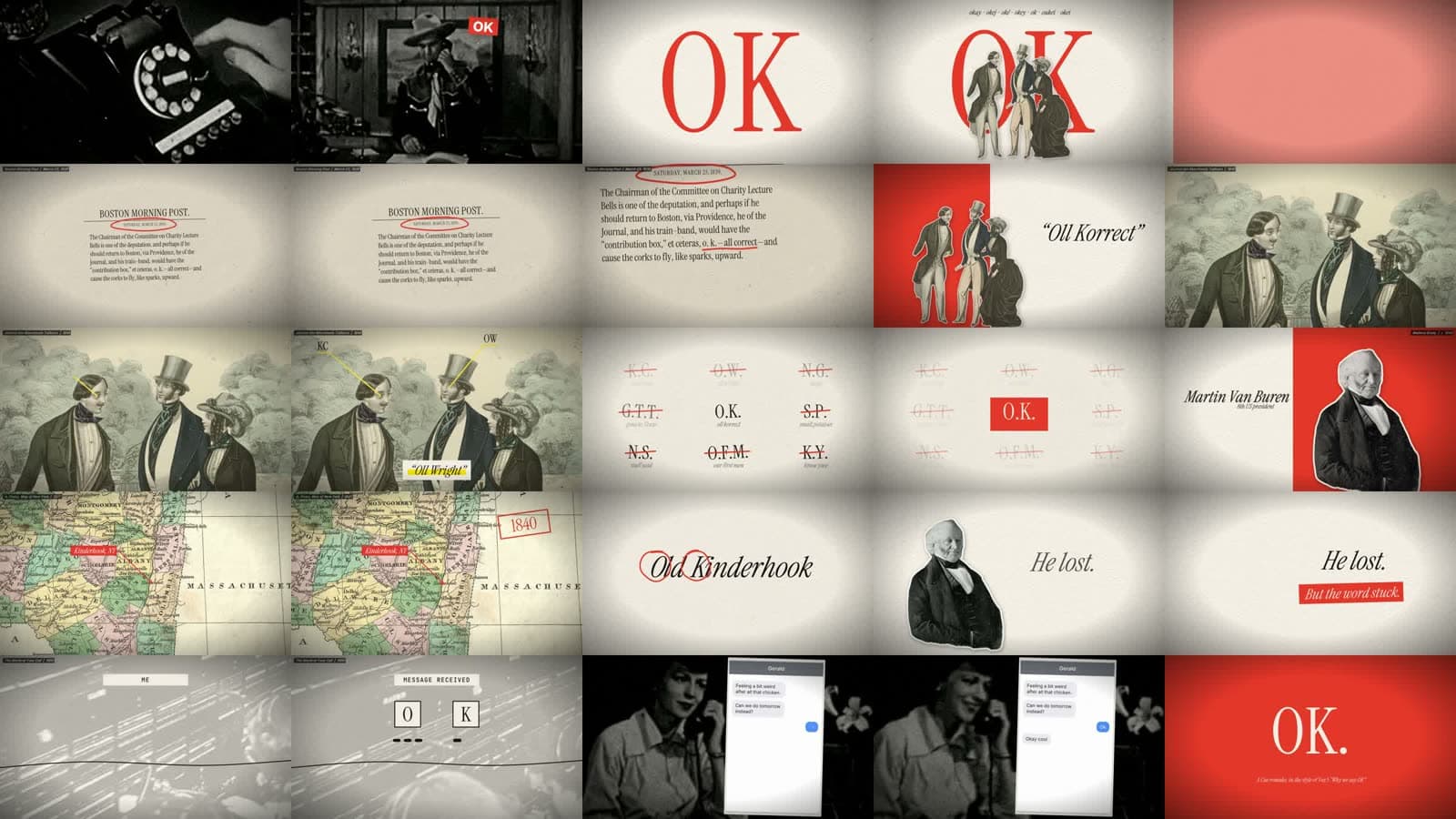
A 73-second remake of Vox's explainer “Why we say OK”, made in Cue by an agent as a test of the editor: archive film, cut-outs on red, newspaper clippings with hand-drawn marks, a map, grain and sound, all from public domain sources.
Original: Why we say “OK” by Vox
The original explainer is by Vox. We made this remake as a test: could an agent working in Cue recreate the way Vox edits (the archive cut-outs, the paper, the marks, the pacing) from its own script and public domain material? The idea, the story and the style are Vox's; the material and the build are new.
The project opens in Cue 0.2 or later: unzip it and double-click the .cueproj. Every picture, film and sound in it is public domain or CC0; the sources are listed below and in its README.
14
Scenes
30
Motion graphics
40
Sound effects
4 public domain
Sources
How it was made
An agent built the whole video through Cue's MCP tools, following the Vox playbook. The full build, scene by scene, is the playbook example-why-we-say-ok that every agent connected to Cue can read.
Step 1
Measure the reference
analyze_reference on the original gave the brief: 17.7 cuts a minute, a median shot of 1.8 s, 83% black and white, paper white and ink covering half the picture, −20.5 LUFS.
Step 2
Script and voice
Eight lines of about 150 words, voiced with text-to-speech. Word timings from the transcript drive every mark, so a circle lands two frames before its word.
Step 3
Find what may be used
A 1950 telephone film from the Prelinger Archives, an 1845 fashion plate from the Rijksmuseum, Mathew Brady's portrait of Van Buren and an 1827 map of New York: all public domain. Paper, newsprint and sounds come from Cue's library.
Step 4
Cut-outs and archive
cut_out lifted the figures and the portrait out with a paper edge and a shadow. The archive film is graded black and white with grain, pushed in slowly, with red OK tags popping next to each caller.
Step 5
Graphics and marks
Thirty motion graphics from templates and specs: the clipping, red blocks, circles and underlines that follow the clipping's punch-in, highlighter, leader labels, a location tag, the telegraph and a chat.
Step 6
Texture and sound
One adjustment layer adds vignette and grain to everything. Forty effects land on slaps, slams, pushes and marks; an original music bed stops for a beat before "He lost."
Step 7
Check and package
render_frame at every scene and mark, an export, then analyze_reference on the export to compare with the reference. package_project made the download below.
Make it again from scratch
Connect your agent to Cue, open Cue, and paste this prompt into Claude Code, Codex, Gemini CLI or any MCP client. It takes an agent about an hour and uses text-to-speech for the voice (an OpenAI key in Cue's AI settings, or record the lines yourself).
claude mcp add --scope user cue -- node "/Applications/Cue.app/Contents/Resources/mcp/cue-mcp.mjs"
Run once in a terminal; Cue is then available in every folder.
Make a 70–75 second remake of Vox's explainer "Why we say OK" (https://www.youtube.com/watch?v=1UnIDL-eHOs) in Cue. Recreate how Vox edits, not its artwork: use only public domain and CC0 material, credit every source, and credit Vox as the original on the end card.

1. Read Cue's playbooks first: get_playbook "working-in-cue", "vox-explainer" and "example-why-we-say-ok". The last one is this video written down scene by scene: follow it.
2. Create a 1920×1080, 30 fps project. Script (8 lines):
   L1 There is a two-letter word you have probably said today without even thinking about it.
   L2 OK. It might be the most widely understood word on the planet. And it started as a joke.
   L3 In March 1839, the Boston Morning Post printed a strange little abbreviation: o. k., all correct.
   L4 Spelled wrong on purpose: oll korrect. Papers at the time were full of joke abbreviations like that, K C for knuff ced, O W for oll wright.
   L5 Almost all of them were forgotten within a year. OK was not, thanks to a president.
   L6 Martin Van Buren came from Kinderhook, New York. When he ran for re-election in 1840, his supporters called him Old Kinderhook, and started O.K. clubs.
   L7 He lost. But the word stuck. The telegraph needed a short reply that meant: message received. O K.
   L8 And today it is how we say yes without saying very much at all.
   Generate the voiceover and get word timings with get_transcript.
3. Download and import these public domain sources:
   - https://archive.org/details/WorldAtYourC ("The World at Your Call", 1950): telephone calls, telegraph poles, a switchboard
   - https://commons.wikimedia.org/wiki/File:Journal_des_Marchands_Tailleurs,_juin_1845,_No._97,_RP-P-2009-3238.jpg
   - https://commons.wikimedia.org/wiki/File:Martin_Van_Buren_daguerreotype_by_Mathew_Brady_circa_1849.jpg
   - https://commons.wikimedia.org/wiki/File:1827_Finley_Map_of_New_York_State_-_Geographicus_-_NewYork-finley-1827.jpg
   Use cut_out on the fashion plate and the portrait. Take paper, newsprint and sound effects from list_library_assets.
4. Build it scene by scene as in the example: archive cold open with red OK tags, the big red OK with the people in front, the clipping with marks that follow its punch-in, red blocks with cut-outs, the map push-in, the Old Kinderhook → O.K. type animation, the telegraph, the chat, the end card. Put grain and a vignette over everything with one adjustment layer, sound effects on every landing and push, and a music bed that stops before "He lost".
5. Check every scene and every mark with render_frame. Export to export/why-we-say-ok.mp4 (wait_for the result), look at frames of the file, and run analyze_reference on it: aim for 15–20 cuts a minute, mostly black and white, about −16 LUFS. Fix what is off and export again.
6. package_project with a README listing the sources.
Sources
- Original video: “Why we say OK” by Vox (idea, story and editing style) · © Vox Media, credited as the original
- The World at Your Call (1950), Prelinger Archives · Public domain
- Journal des Marchands Tailleurs, June 1845 (Rijksmuseum) · Public domain
- Martin Van Buren, daguerreotype by Mathew Brady, c. 1849 (Library of Congress) · Public domain
- A. Finley, Map of New York, 1827 · Public domain
- Paper and newsprint textures, ambientCG · CC0
- Sound effects, Kenney and Cue · CC0


A remake of Vox's “Why we say OK”, made as a test of what Cue can do: the idea, story and editing style are Vox's; the material and the build are new. Not affiliated with or endorsed by Vox Media. The Boston Morning Post clipping is re-set in type from its 1839 text.
Make your own
Free and open source · Apple Silicon · Other platforms · Source