
Examples · Archive history documentary
The Red Cars
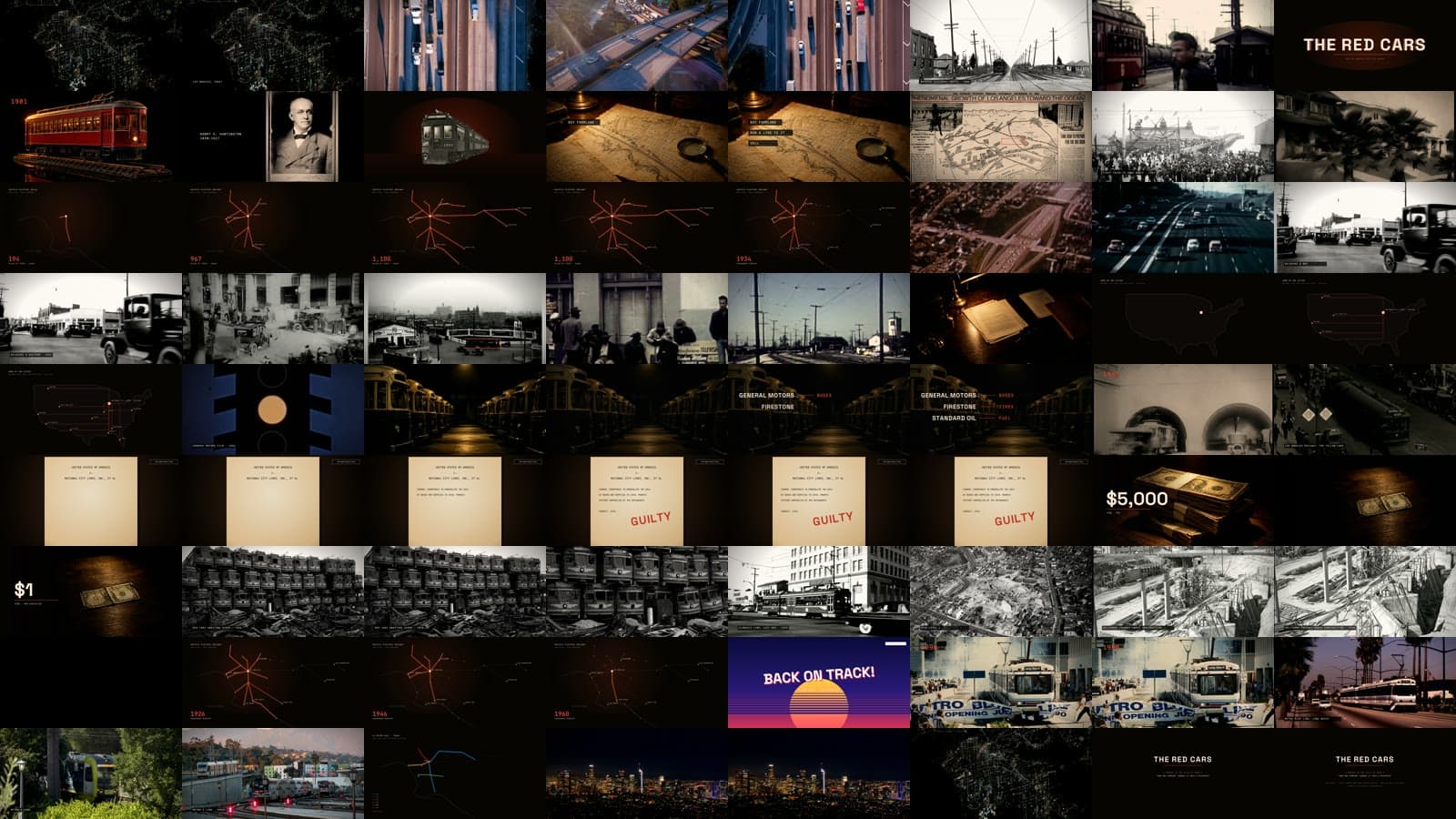
A 3½-minute history documentary in the style of Hoog, made in Cue by an agent as a test: glowing rail maps on black, warm film archive, lamp-lit evidence, three voices and an original score, from public domain and open-licence sources.
Original: How One Company Turned LA Into A Dystopia by Hoog
The original documentary is by Hoog. We made this shorter remake as a test: could an agent working in Cue recreate the way Hoog edits (the glowing maps, the orange film archive, the evidence on a desk, the voices) from its own script and public domain and openly licensed material? The subject and the style are Hoog's; the script, voices, graphics, music and the build are new, and nothing from the original video is used.
The project opens in Cue 0.2 or later: unzip it and double-click the .cueproj. Every picture, film and sound in it is public domain or CC0; the sources are listed below and in its README.
45
Shots
17
Motion graphics
3
Voices
26 open
Sources
How it was made
An agent built the whole video through Cue's MCP tools, following the Vox playbook. The full build, scene by scene, is the playbook example-why-we-say-ok that every agent connected to Cue can read.
Step 1
Measure the reference
analyze_reference on the 19-minute original: a 2:1 frame, a median shot of 3.3 s, about 11 cuts a minute, black filling half of every frame, 56% black and white, −16 LUFS. Contact sheets of every shot showed the grammar: warm film archive, glowing line maps, evidence on a desk, newsreel, aerials.
Step 2
A new, shorter script
473 words of its own covering the Pacific Electric's rise, its peak of about 1,100 miles of track, the 1949 National City Lines case, the freeways and the return of rail, voiced in ten passages so the narrator stays consistent. A flat, filtered records voice reads the charges and the fines; a period announcer, labelled as a dramatisation, reads two lines.
Step 3
Find what may be used
26 sources, every licence checked on its own page: 1916–1959 films from the Prelinger Archives and archive.org, pre-1929 photographs and maps, CC BY photos from the Los Angeles Times and Commons photographers, NASA night photos. The archive segments used were restored (denoised, upscaled, sharpened).
Step 4
Cut on words
Every cut, graphic and sound is anchored to a word of the narration from the transcripts, three frames early, so a new take only means re-running the layout.
Step 5
Maps, marks and evidence
The network drawn from real stop coordinates grows to 1,100 miles, then fades line by line to 1961 and fills in again as today's Metro. Red boxes draw on a stuck streetcar and a 1912 real-estate map; a train is cut out onto a red glow; a typed case file is stamped guilty; generated tabletop stills carry the money.
Step 6
Sound
One continuous original score: a drone that drops out before “Then came a buyer”, a heartbeat under the investigation, a major lift for the return. Thuds, shutters, typewriter and ticks land on the graphics; room tone fills the silences. Mixed to −16.4 LUFS.
Step 7
Check, fix, and write it down
Two full passes, each exported and checked frame by frame and second by second. Everything that went wrong (and the Cue bugs it uncovered) is in the playbook 'before-your-first-pass' so the next build starts from the second pass.
Make it again from scratch
Connect your agent to Cue, open Cue, and paste this prompt into Claude Code, Codex, Gemini CLI or any MCP client. It takes an agent about an hour and uses text-to-speech for the voice (an OpenAI key in Cue's AI settings, or record the lines yourself).
claude mcp add --scope user cue -- node "/Applications/Cue.app/Contents/Resources/mcp/cue-mcp.mjs"
Run once in a terminal; Cue is then available in every folder.
Make a 3–4 minute history documentary in the style of Hoog's "How One Company Turned LA Into A Dystopia" (https://www.youtube.com/watch?v=M0Hv7nxmS2I) in Cue, about Los Angeles' Pacific Electric Red Cars. Recreate how Hoog edits, not the video: use only public domain and openly licensed material, credit every source, and credit Hoog as the original on the end card.

1. Read Cue's playbooks first: get_playbook "working-in-cue", "before-your-first-pass", "archive-history-documentary" and "example-the-red-cars" (this video written down).
2. Create a 1920×960, 24 fps project. Script (narrator passages P, a records voice R, a dramatised announcer A):
   P01 This is Los Angeles. Nearly five hundred square miles of city, stitched together by freeways. Every day, millions of people sit in some of the slowest traffic in America. But a century ago, you could cross this whole region without a car. On a train painted red.
   P02 In 1901, a railroad heir named Henry Huntington founded the Pacific Electric Railway. And his plan wasn't really about trains. Buy empty farmland at the edge of the city. Run a line out to it. Then sell the land, as a brand new town. It worked. Towns grew up around the stations: shops on the main street, homes a short walk away, and the city one ride away.
   P03 By the 1920s the Red Cars ran on more than a thousand miles of track, across four counties. The largest electric interurban railway in the world. And within forty years, almost all of it was gone.
   A01 Tomorrow's city belongs to the motorist! Wide new roads, and freedom for every family!
   P04 Los Angeles fell for the car early. By the late twenties it had more cars per person than almost anywhere. The trains shared the streets with them, and got stuck behind them. Trips got slower. Riders drifted away. The companies stopped paying for repairs.
   P05 Then came a buyer.
   P06 From the late 1930s, a company called National City Lines bought up streetcar systems in dozens of American cities. Behind it: General Motors, Firestone Tire, and Standard Oil of California. Where it took over, the rails came out and buses went in. General Motors buses, on Firestone tires, burning Standard Oil fuel. In 1945 it bought the city's other streetcar network, the Yellow Cars.
   R01 The United States of America, versus National City Lines, et al.
   P07 In 1949, a federal jury convicted the companies of conspiring to monopolize the sale of buses and supplies to the transit systems they controlled.
   R02 Each corporation. Fined five thousand dollars.
   R03 Each executive. One dollar.
   P08 Whether they killed the streetcar on purpose is still argued about. Many historians say the Red Cars were already dying. But nobody was fighting to save them. The state was pouring its money into freeways instead. Through Cahuenga Pass, the Red Cars ran down the middle of the new Hollywood Freeway. Then the rails were paved over.
   P09 On April 9th, 1961, the last Red Car left Los Angeles for Long Beach. The line that started it all was the last to close.
   A02 Los Angeles is getting back on track!
   P10 Twenty-nine years later, a new train opened on nearly the same route. The Metro Blue Line, from downtown to Long Beach. Today the city is building rail again, faster than almost anywhere in America. Line by line, the map is filling back in.
   P11 Los Angeles never forgot how to build around a train. It just spent sixty years paving over the proof.
   Voice the narrator passages with one voice and one set of instructions; transcribe every take and compare it with the script. Put the records and announcer voices on their own tracks with the EQ from the playbook.
3. Source public domain and CC-licensed material (Prelinger Archives, archive.org, Wikimedia Commons, NASA), checking each licence on its page; look at the frames before choosing in-points, and restore the film segments you use.
4. Build scene by scene, every cut anchored to a word: the glowing network map that grows and fades, marks on the photos and maps, the cut-out train, the case file and the fines, year stamps and labels on every archive picture, one continuous score, effects on every landing.
5. Export, then check the file: a contact sheet every 2 s, black frames, loudness per second, the voice against the script. Fix and export again.
6. package_project with a README listing every source and its licence.
Sources
- Original video and style: “How One Company Turned LA Into A Dystopia” by Hoog · © Hoog, credited as the original
- 'A Visitor to Los Angeles' (Ford Educational Weekly, 1916) · Public domain (published 1916, pre-1929; archive.org item has no licence field) · Ford Educational Weekly, 1916 (public domain)
- 'Freeway Driving' (Fass-Levy Films, c.1959) (c. 1959) · Public domain (Prelinger Archives rights field: 'No copyright notice seen on film'; no licenseurl) · Freeway Driving, Fass-Levy Films c.1959, Prelinger Archives
- 'Give Yourself the Green Light' (General Motors, 1954) · Public domain (Prelinger Archives, archive.org licenseurl = publicdomain) · Give Yourself the Green Light, General Motors 1954, Prelinger Archives (public domain)
- 'Hollywood Snapshots' (1922), Hollywood Boulevard streetcar clip · Public domain (pre-1929 publication) · Hollywood Snapshots, 1922 (public domain)
- 'Into the Future' (1922), first 4 minutes · Public domain (archive.org rights: 'Public domain. No restrictions on use.') · Into the Future, 1922, City of Los Angeles (public domain)
- 'The Towers' (1957), William Hale · Public domain (Prelinger Archives, archive.org licenseurl = publicdomain) · The Towers (1957), William Hale, Prelinger Archives (public domain)
- Four-level interchange under construction (aerial) (1948) · CC BY 4.0 · Goodyear Tire and Rubber Co. / Los Angeles Times Photographic Archive, UCLA Library / CC BY 4.0
- Construction of the Hollywood and Santa Ana freeways (1946) · CC BY 4.0 · Los Angeles Times Photographic Archive, UCLA Library / CC BY 4.0
- Henry E. Huntington, portrait (c. 1910) · Public domain (pre-1929 publication / expired US copyright) · Bain News Service, publisher / public domain, via Wikimedia Commons
- Traffic congestion at North Broadway and Sunset (1922) · Public domain (pre-1929 publication / expired US copyright) · Unknown photographer / public domain, via Wikimedia Commons
- Traffic at the 'Magic Circle', Wilshire & Western (1922) · Public domain (pre-1929 publication / expired US copyright) · Unknown photographer / public domain, via Wikimedia Commons
- 'Phenomenal Growth of Los Angeles Toward the Ocean' (1912) · Public domain (pre-1929 publication / expired US copyright) · Staff artist / public domain, via Wikimedia Commons
- Blue Line train on Long Beach Blvd, 1995 · CC BY 2.0 · David Wilson / Wikimedia Commons / CC BY 2.0
- Metro Blue Line opening celebration, 14 July 1990 · Public domain (PD-CAGov, LA Metro Library & Archive) · Dorothy Peyton Gray Transportation Library and Archive at the Los Angeles County Metropolitan Transportation Authority / public domain, via Wikimedia Commons
- Downtown Los Angeles at night from Griffith Observatory (2019) · CC BY-SA 4.0 · Camiloarenivar / Wikimedia Commons / CC BY-SA 4.0
- Hollywood Freeway north of Cahuenga Pass (2013) · CC BY-SA 3.0 · Mateusz Kudła / Wikimedia Commons / CC BY-SA 3.0
- City lights of Los Angeles from the ISS (2024) · Public domain (NASA, US federal government work) · NASA Johnson Space Center / public domain, via Wikimedia Commons
- Aerial views of freeway in Los Angeles (drone, 2021) · CC BY 3.0 · the Dronalist / Wikimedia Commons / CC BY 3.0
- LA Metro A Line train near South Pasadena (2026) · CC BY 4.0 · Julesucks / Wikimedia Commons / CC BY 4.0
- LA Metro A Line and Metrolink trains at Union Station (2025) · CC BY 4.0 · RailTypes / Wikimedia Commons / CC BY 4.0
- Pacific Electric Building, Sixth & Main (c. 1905-1909) · Public domain (pre-1929 publication / expired US copyright) · Unknown photographer / public domain, via Wikimedia Commons
- Last day of Glendale-Burbank line (railfan special) (1955) · Public domain (PD-CAGov, LA Metro Library & Archive) · Los Angeles County Metropolitan Transportation Authority / public domain, via Wikimedia Commons
- Long Beach Line train under signal gantry (1923) · Public domain (pre-1929 publication / expired US copyright) · Pacific Electric Railway / public domain, via Wikimedia Commons
- Opening day of the Pacific Electric line at the Long Beach Pier (c. 1902) · Public domain (pre-1929 publication / expired US copyright) · Unknown photographer / public domain, via Wikimedia Commons
- Pacific Electric Red Cars awaiting destruction (1956) · CC BY 4.0 · Los Angeles Times Photographic Archive, UCLA Library Special Collections / CC BY 4.0
- PE train at 103rd Street, Watts (1906) · Public domain (pre-1929 publication / expired US copyright) · Metro Library and Archive / public domain, via Wikimedia Commons
- Sound effects, Kenney and Cue · CC0

,_Los_Angeles,_1946.jpg)

.jpg)
.jpg)

.jpg)


.jpg)


.jpg)
.jpg)

_at_the_Long_Beach_Pier,_ca.1900-1902_(CHS-1989).jpg)


A remake of Vox's “Why we say OK”, made as a test of what Cue can do: the idea, story and editing style are Vox's; the material and the build are new. Not affiliated with or endorsed by Vox Media. The Boston Morning Post clipping is re-set in type from its 1839 text.
Make your own
Free and open source · Apple Silicon · Other platforms · Source